



Research
Research is essential to ensuring people with Down syndrome receive the most effective support from infancy through to old age. At Down Syndrome Ireland, our research department acts as a vital bridge between scientific evidence and daily practice, ensuring all our advice and services are grounded in the latest global best practice.
To keep Ireland at the forefront of development, we collaborate with leading academic and medical bodies, including Trinity’s DISCO group and the Down Syndrome Medical Interest Group (DSMIG). By presenting at international forums and responding to global research requests, we ensure our community remains connected to the latest advancements in the field.
Led by our National Research and Support Specialist Nicola Hart, we work directly with universities to identify critical research needs and promote public engagement. Our goal is to ensure that research is a collaborative process that truly reflects the lived experiences and needs of individuals with Down syndrome and their families.


Research Opportunities
- Brain health: Dr Antoinette O’Connor from the National ID Memory Clinic in Tallaght is recruiting adults with Down syndrome aged 18+. This research looks at blood cells to find out if they could be used for early diagnosis of brain changes.A trial-ready cohort of older adults is also being recruited at the memory clinic, so that people with Down syndrome can be included in research trials focusing on Alzheimer’s disease.
- Adults aged 35+ Language and Ageing: Exploring changes in functional reading, language abilities, and everyday functional skills over time, in a cohort of adults with Down syndrome. This is a DSI project, working together with UCC. We are exploring whether an annual language assessment and carer checklist for people with Down syndrome aged 35+ could be useful for members. We are currently recruiting adults over 35 along with a family member or key-worker who knows them well. Contact nicola@downsyndrome.ie if you would like to be involved.
- Experiences of breastfeeding a child with Down syndrome: There is a nationwide study in Ireland on mothers’ experiences of breastfeeding their child with Down syndrome. If your child is 5 years old or younger, you can share your experiences via a survey. The survey will take approximately 15 minutes. For further information contact Fiona on Fiona.Mcgrane@tuh.ie.
- For parents of adolescents aged 11-18: Relationship between wellbeing and social participation in adolescents. This is an MSc research project looking at the relationship between participation in social and recreational activities and wellbeing in young people with additional needs. Participation is through an anonymous survey, which will take around 5-10 minutes. For further enquiries, you may contact Maayan on maayan.kornbluth@ucdconnect.ie.
- BabblePlay Project: There is a team of researchers at the Universities of York and Manchester, currently running a study called the BabblePlay project, in collaboration with Down Syndrome Education International (DSEI). The study involves testing a parent-led app designed to support early vocal development in babies with Down syndrome. Recruitment has already started in the UK, but they would like to recruit participants in the Republic of Ireland as well. The team are looking for English-speaking families with a baby with Down syndrome aged 7-15 months to take part (families can sign up when their baby is 3-13 months old).
Participation takes place at home and involves using the app for 6 weeks (if in the intervention group), alongside completing home audio recordings and online questionnaires. People will be allocated to intervention or control.
- Adults with Down syndrome aged 25+: Dr Sarah Doyle, Professor In Immunology, Clinical Medicine, Trinity Inst. of Neurosciences (TCIN) is working with Katie Robb at Progressive Vision in the Beacon, Sandyford to explore eye health and ageing in adults with Down syndrome. Everyone has changes in their eyesight as they get older. Changes in eyesight might happen earlier for people with Down syndrome. We need to know more about eye changes in people with Down syndrome. We need research about eye aging in people with Down syndrome. Trinity College Dublin and Progressive Vision Research are working on a research project. If you are aged 25 or older, you can join the research. Contact: Sarah.Doyle@TCD.ie.
- Access to Justice and Participation: Trinity College Dublin and Inclusion Ireland are working on a research project called Access to Justice and Participation: How nonspeaking people with intellectual disabilities should have their voices heard and their rights upheld. If you are interested in taking part, or you want more information, you can contact Caroline Sherman on 01 896 4029, or Caroline.J.Sherman@tcd.ie.
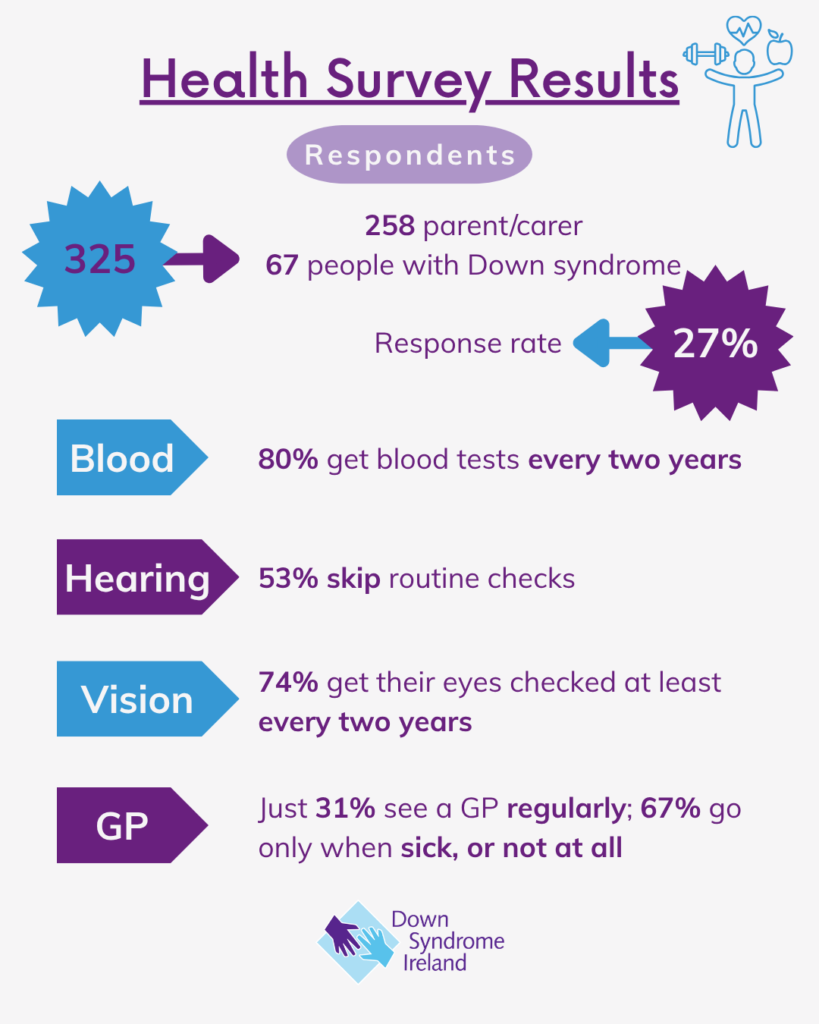
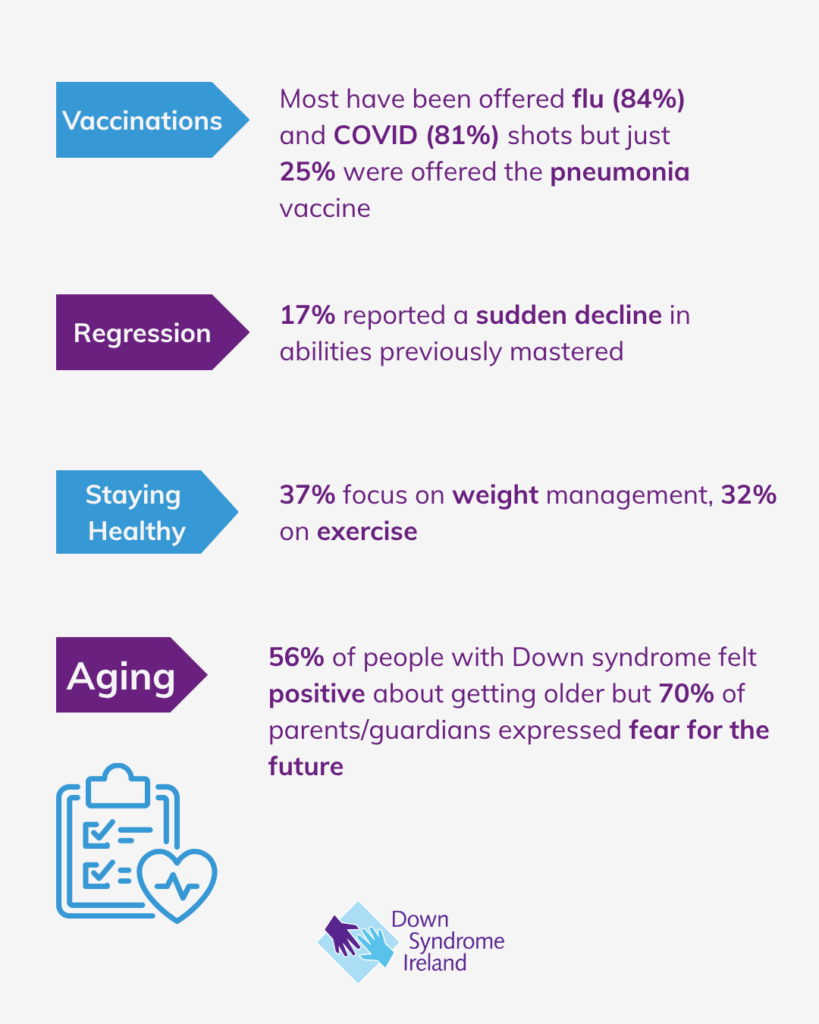
Health Survey Results
You can find the results to the 2025 Health Survey here.
Trinity Research
Nicola Hart works closely with the team in Trinity on many research projects. The Discipline of Paediatrics’ Down Syndrome Research Group (DISCO) welcomed the wider Down syndrome community to Trinity in March 2025 and 2026 to hear about all the developments in Down syndrome research. Click the links for each year and scroll to find the recordings.
- Una Coates from Down Syndrome Ireland. Una sits on DSI’s National Advisory Council. She also sits on the Down Syndrome Research Priority Setting Partnership Steering Group.
- A Joint Adventure… Down syndrome associated arthritis (DA) the past, the present and the future! – Dr Orla Killeen, Consultant in Rheumatologist, CHI Crumlin
- Keratoconus in Down syndrome – Mr Barry Power, Consultant Ophthalmic Surgeon in RVEEH and Blackrock Clinic
- New Areas of Research in Down syndrome – Dr Robert McCarthy, MB, BCh, BAO, BA (Mod), MRCPI, 4th year SpR in Paediatric Medicine. Rob is currently undertaking a PhD with Trinity College, with the majority of his research focusing on the immune system of children with Trisomy 21.
- Progressing Early Intervention – Elaine McMahon, Clinical Specialist Occupational Therapist, Neonatology Children’s Health Ireland
- The Happy Project: Fostering independence and autonomy in young people with Down syndrome – Beth Corcoran, Programme Mgr and PPI Contributor, Disc of Paediatrics, Trinity College Dublin
- Ross O’Neill from Down Syndrome Ireland. Ross has been working at DSI for 15 years and plays central role at the National Office as well as being a member of DSI’s National Advisory Council.
- Dr Robert McCarthy, MB, BCh, BAO, BA (Mod), MRCPI, 4th year SpR in Paediatric Medicine. Rob is currently undertaking a PhD with Trinity College, with the majority of his research focusing on the immune system of children with Trisomy 21.
- Professor Orla Franklin, Paediatric Cardiologist, CHI Crumlin and Temple Street.
- Fiona McGrane, Clinical Nurse Specialist for children with Down syndrome. Fiona was instrumental in establishing the first Down syndrome clinic in Ireland in 2015. Fiona is also part of the DISCO research team which has produced numerous publications within the area of Down syndrome and has positively impacted on the health screening which is carried out in the clinic, treatment pathways and the development of a clinical Performa. She provides nationwide support to children and their families.
- The DISCO team also introduced our new Trinity Ambassador for Research in Down Syndrome, Andrew McCarthy.
- Professor Eleanor Molloy, Chair of Paediatrics at Trinity College Dublin and Consultant Neonatologist presented DISCO Next Steps – The Future.
Upcoming Projects
Upcoming projects this year, pending confirmation, include:
- Survey to look at how participation in social and recreational activities affects the wellbeing of adolescents with additional needs.
- Large scale international project looking at the development and use of smart fabrics to support health.
- International project looking at understanding and addressing online scams targeting people with Down syndrome.
Ongoing Projects and Partnerships
- Membership of the DSMIG (Down syndrome Medical Interest Group)
- Membership of the DISCO group (based in Trinity, focused on paediatric medical research)
- Longitudinal Study on Ageing with ID in Ireland
- Down Syndrome Priority Setting Partnership. People with Down syndrome around the world identifying priorities for research. Meetings are facilitated by TCD, with DSI representative Una Coates from the National Advisory Council (NAC).
Outcome of Previous Projects
Early Years Music Project
This project aimed to provide parents with a play-based online music and signing resource to support their child’s early communication development.
- 80 families were involved with the project in 2022-2023.
- The results of this feasibility study were evaluated and published in 2024:
- The feasibility of an online language intervention delivered through music and the impact of dosage on vocabulary outcomes in young children with Down Syndrome.
- The next step is to look for funding to remake the videos based on parent feedback, then investigate outcomes in both homes and early childhood education settings.
Meaningful Reading Project
Very little was known about how adults with Down syndrome use their literacy in everyday life. This is important information for primary and post-primary teaching as well as for designing adult literacy programmes.
This was a co-designed piece of research, which started by asking adults with Down syndrome to notice all the times they used written information – from recognising their name or finding a TV channel, to looking things up on the internet or reading a book. The results were published and the link is here.
The checklist that was co-designed will be used as part of a new DSI/UCC research project which will find out if it is a useful measure to pick up changes in reading habits over time.
